
Buyer comparison
Schoolyi and Classe365: how they differ
Classe365 describes itself as student management system for schools and higher education. This page sets out what it publishes about itself, where it is strong, which schools it suits, and where Schoolyi works differently.

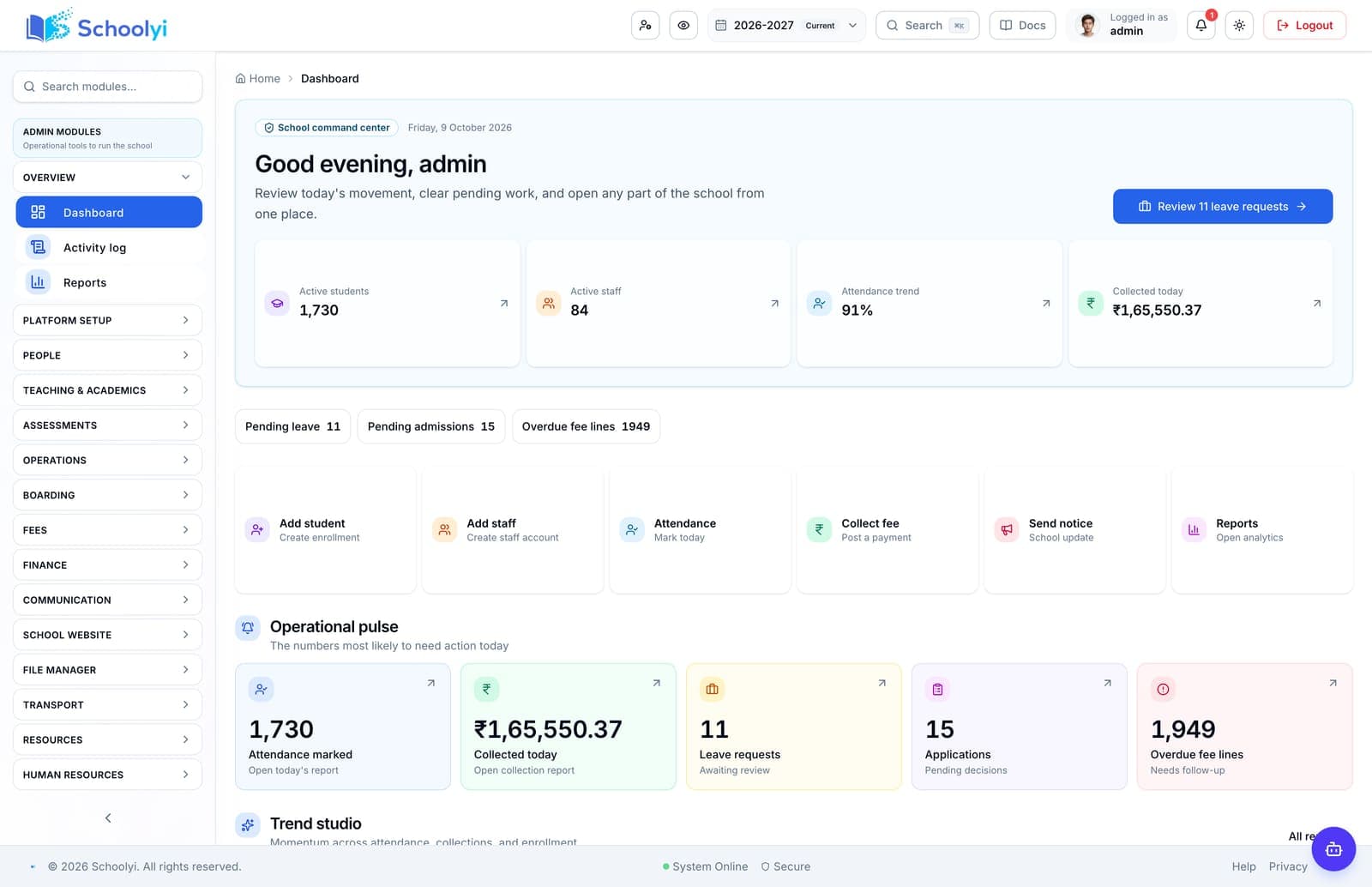
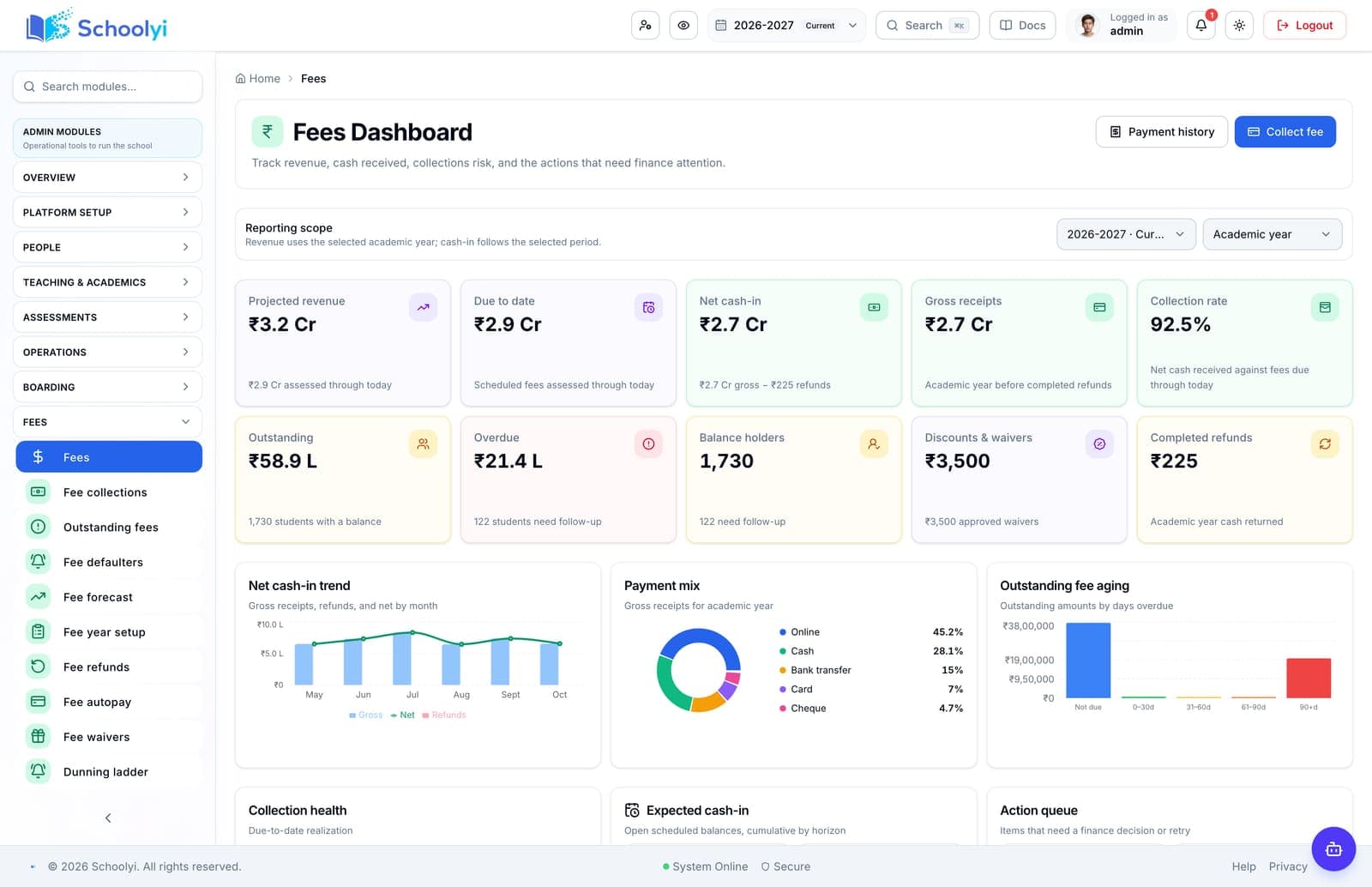
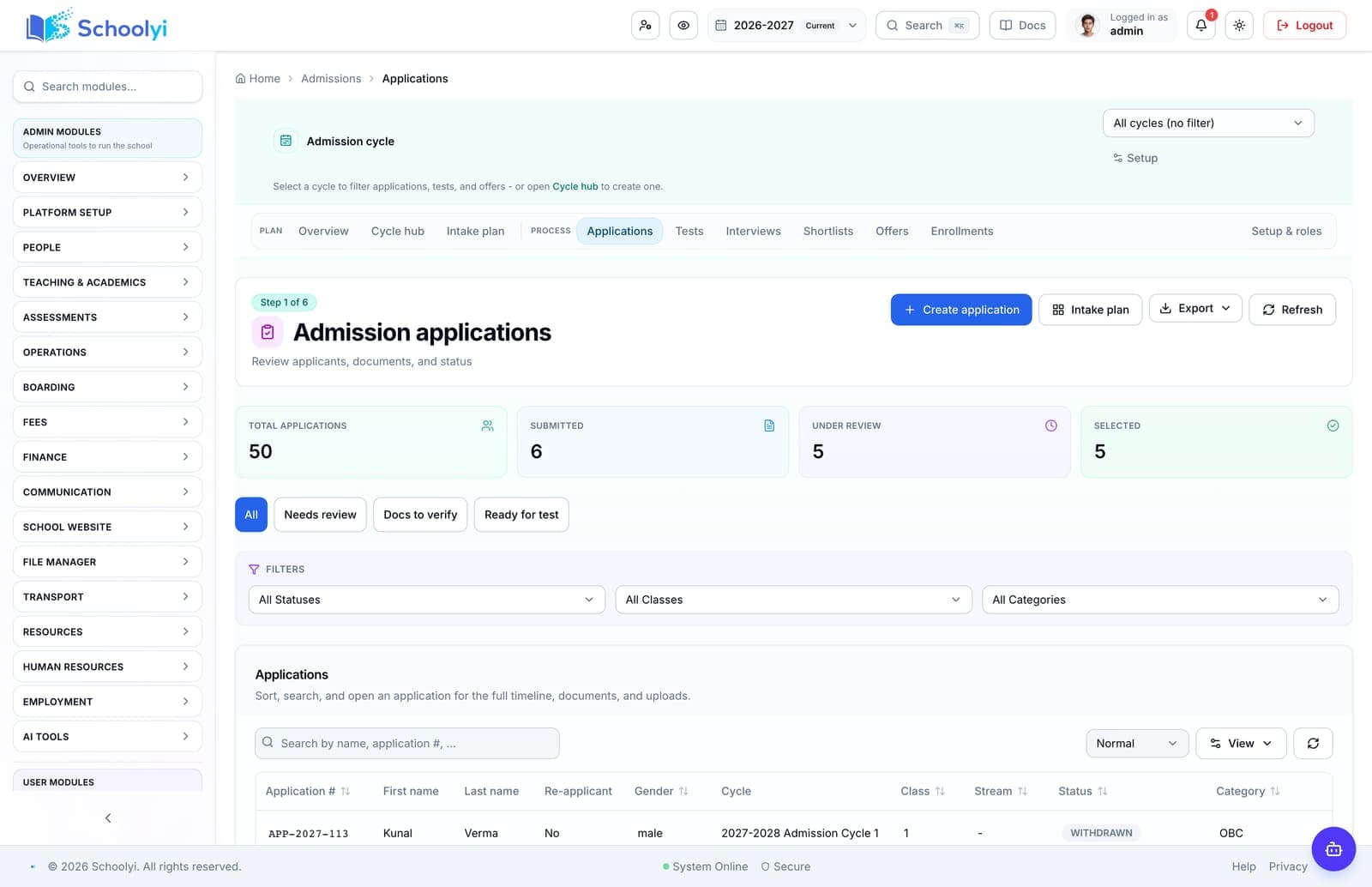
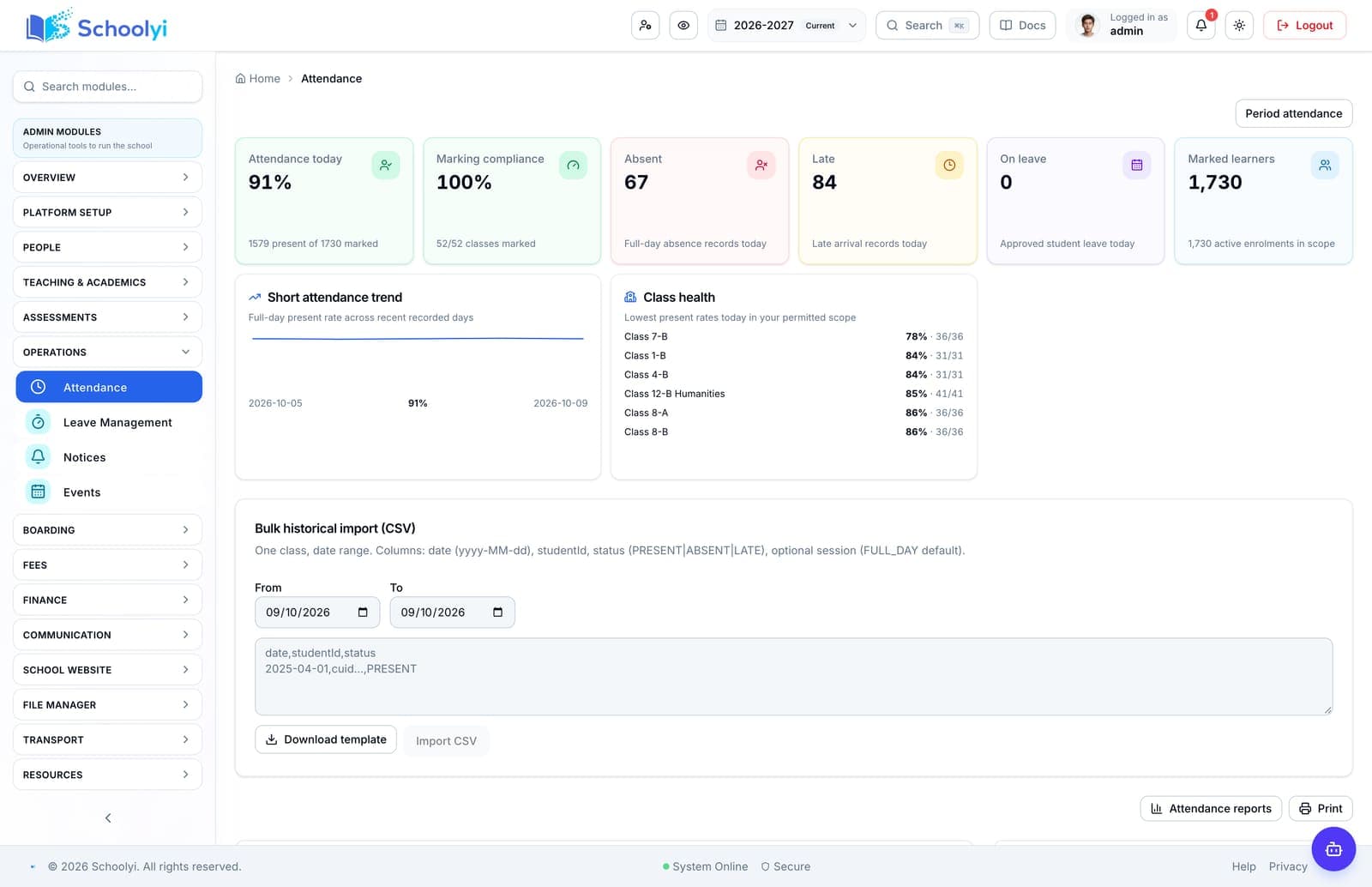
Schoolyi screens
The product these pages are comparing
Command center, fees, admissions, and attendance from a Schoolyi demo school.
Evidence basis
Where the facts on this page come from
Checked against Classe365's own published pages. Nothing here is sourced from a review site, an analyst summary, or a sales conversation.
We have no published switcher case studies. Nothing on this page describes a school that moved between these platforms, because we hold no permissioned account of one. The migration notes below are what any move of this kind requires, not a record of one we have run.
- Classe365, Pricing, read 29 August 2026
This page was last checked against those sources on 29 August 2026. If it falls out of date, it stops being published rather than staying up unverified.
Classe365
What Classe365 is
Described in Classe365's own terms before any comparison.
Classe365 is a student management platform serving both K-12 and higher education, in operation since 2013 and reporting users across 130 countries. It is one of the few vendors in this category to publish an itemised price list rather than routing every enquiry to sales.
Commercially it is structured as a core module priced by student band, starting at $100 per month for 1 to 100 students, with a set of add-on modules each at $75 per month. Those add-ons include the fee and invoicing module, finance and accounting, the learning management system, CRM and enrolment forms, alumni, white label, fundraising, degree audit, and an AI module.
Professional services are priced separately and published: optional set-up, implementation and data migration from $2 per student virtually or $1,500 per day on site, with training and integration services free virtually and $1,500 per day on site. Pricing is by student count only, with unlimited teacher and parent accounts.
Sourced facts
- Classe365 publishes a core module price starting at $100 per month for the 1 to 100 student band, with pricing based purely on the number of enrolled students and unlimited teacher, student, and parent accounts.Classe365, Pricing, 29 August 2026
- Fee and invoicing, finance and accounting, the learning management system, CRM-Enrol and Forms, alumni, e-commerce, white label, fundraising, degree audit, education agent, task, and AI are all published as add-on modules at $75 per month each.Classe365, Pricing, 29 August 2026
- Published professional services rates are $2 per student and upwards for virtual set-up, implementation and data migration, and $1,500 per day for on-site implementation, training, integration, or change management.Classe365, Pricing, 29 August 2026
- Classe365 states it has operated since 2013 and reports product usage across 130 countries.Classe365, Pricing, 29 August 2026
- A 15-day full-access free trial is offered with no credit card required, and add-on or core modules can be removed at any point during the subscription.Classe365, Pricing, 29 August 2026
- Inactive and alumni students require the separately priced Alumni module to be managed.Classe365, Pricing, 29 August 2026
Acknowledged
What Classe365 does well
Stated without qualification, because a comparison that finds nothing good in the other product is not a comparison.
- Publishing an itemised price list, including professional services day rates, is unusual in this category and lets a school build a budget without entering a sales process.
- Pricing on student count alone, with unlimited staff and parent accounts, removes a whole class of licensing argument as a school grows.
- A 15-day full-access trial with no card required lets an evaluation team test against real data before committing.
- Being able to remove modules mid-subscription is a genuine commitment to the modular model rather than a one-way upgrade path.
- Serving both K-12 and higher education from one platform suits institutions that span both.
Schools Classe365 is the right choice for
- Schools that want a published price and a self-serve trial rather than a sales-led evaluation.
- Institutions whose module requirements are narrow enough that the add-on model stays economical.
- Organisations spanning school and higher-education programmes.
- Buyers who prefer to assemble capability incrementally and pay only for what they enable.
Fit constraints
Where the fit runs out
These are scope decisions rather than defects. A platform built for one kind of institution is not deficient for being unlike another.
- Fees, invoicing, and finance are add-on modules rather than part of the core. For a fee-paying school, where fee collection is a daily workflow rather than an extension, that is a structural difference worth pricing out fully before comparing headline figures.
- The add-on model means the quoted entry price and the price for a working configuration can be some distance apart, so the comparison to make is total configured cost rather than starting price.
- Managing alumni or inactive students requires a paid module, which is worth checking against your retention obligations.
- Spanning K-12 and higher education requires a data model general enough for both, which is a different design point from one scoped to schools.
Schoolyi
Where Schoolyi works differently
Differences in design, not a scorecard. Some of these will count against us for your school.
Fee collection in the core, not as a module
Instalment plans, sibling and staff discounts, counter receipts, defaulter views, and online payment sit at the centre of Schoolyi rather than being enabled separately, because for a fee-paying school this is a daily workflow rather than an extension.
Scoped to schools
Class sections, guardian relationships, term-based instalments, and school report cards are modelled as a school has them, without the generality required to also serve degree programmes and credit hours.
One shared academic calendar
Working days, holidays, and term boundaries are defined once and read by attendance, fees, timetable, and reporting, so the same date cannot be a working day in one module and not in another.
Quoted against scope rather than assembled from a list
Schoolyi quotes for the scope adopted, including implementation, rather than composing a figure from a module list. That is less transparent up front than a published price list and more predictable once configured, a genuine trade-off, not an advantage.
Migration
What a move between the two would require
General requirements of a migration of this kind. Not a record of one we have run.
- Establish which add-on modules currently hold data. Modules enabled once and abandoned are common under this commercial model and their data is usually not worth migrating.
- Fee and invoicing history needs an agreed opening balance per family before anything moves. This is the single most disputed dataset in a school migration.
- If alumni are held in a paid module, confirm whether that data comes across or is retained separately, particularly where transcript issuance for former students is a statutory obligation.
- Deduplicate guardians before import, and decide which adult is the payer of record for each child.
Read the implementation guides for how a phased rollout is normally sequenced, or looking for a classe365 alternative?.
Schoolyi and Classe365: common questions
Including the questions where the answer does not favour us.
Classe365 publishes prices and Schoolyi does not. Why?+
Because a published figure for us would be misleading rather than transparent: student count, campus count, and implementation effort move the number more than the module mix does.
Classe365 publishing its list is a real advantage during budgeting, and if a published price is what your process requires, that weighs in its favour.
How should we compare the two on cost?+
Price the configuration you will actually run. For Classe365 that means the core module for your student band plus every add-on you need, fees and invoicing, finance, CRM and enrolment, and any others, plus implementation at the published rate.
Compare that total against our quote for the same scope, not against the entry price.
Which suits a fee-paying school better?+
That depends on whether you want fee collection in the core or are content to add it. Schoolyi treats fees, discounts, receipts, and defaulter follow-up as central.
Classe365 offers them as modules, which is more economical for institutions that do not collect tuition. Test your real fee structure, including your most awkward discount rule, in both.
Do you have evidence of schools switching between the two?+
No. We hold no permissioned switcher account and will not imply one.
The migration notes above are the general requirements of a move of this kind.

Bring your own awkward cases to a walkthrough
The fee rule you find hardest to explain, the mid-year transfer, the guardian with children in two year groups. Those decide the fit far better than a comparison page can.
Already using Schoolyi? Sign in