
Alternatives
Considering a PowerSchool alternative
If PowerSchool is not the right fit for your school, this page explains what it is built for, what would make it the right choice anyway, and where Schoolyi differs. Every claim about PowerSchool cites the page it came from.

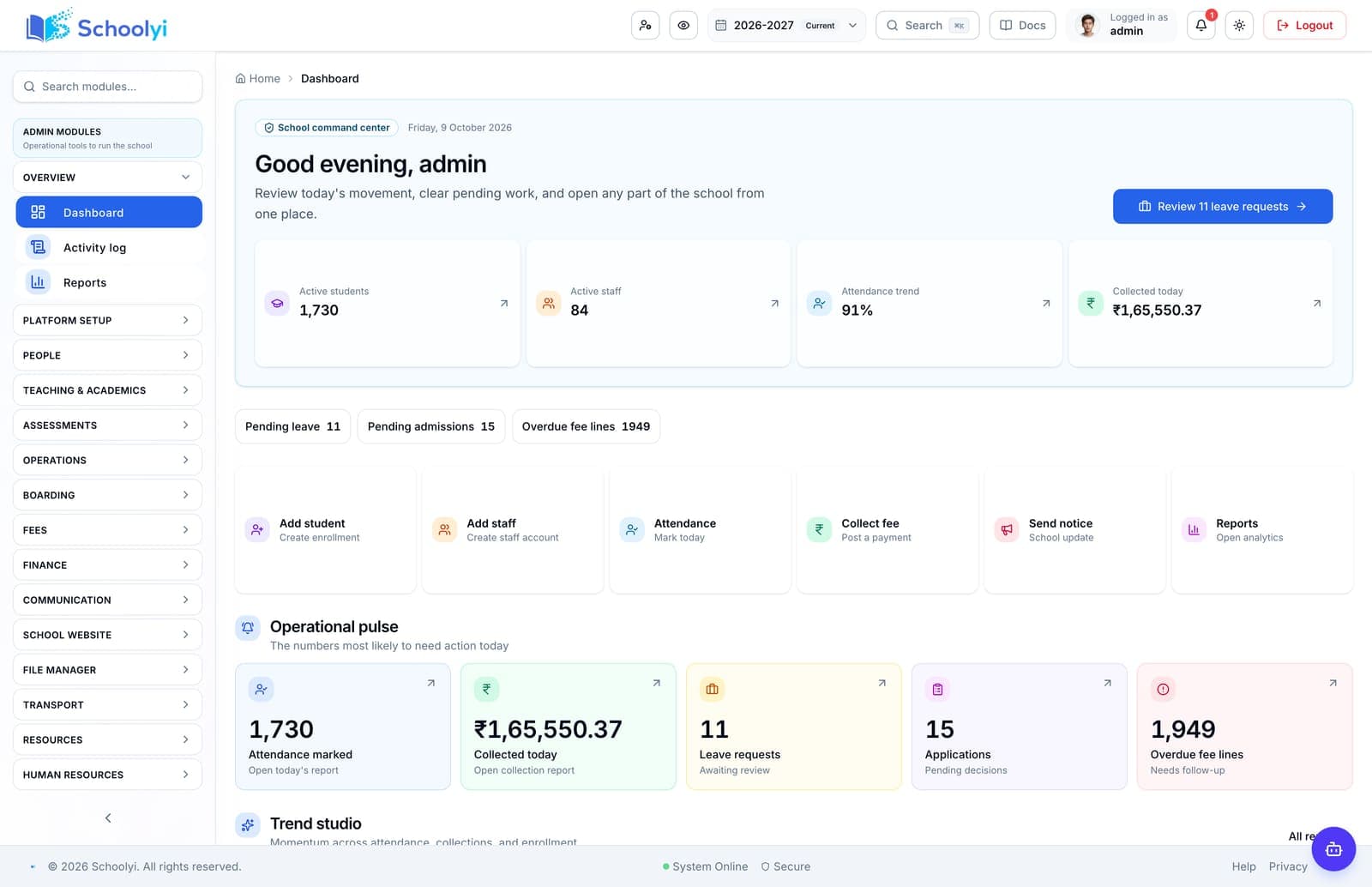
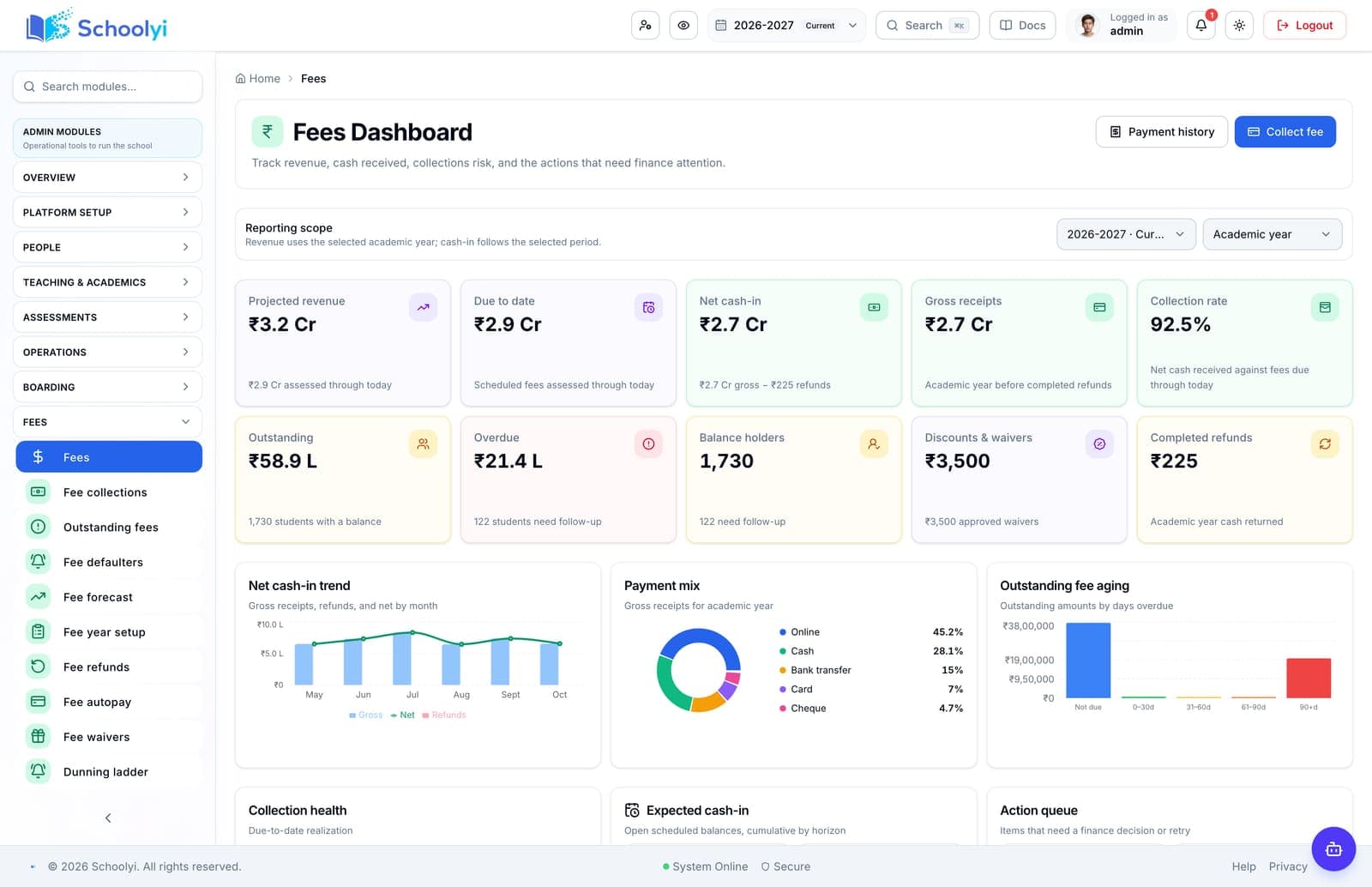
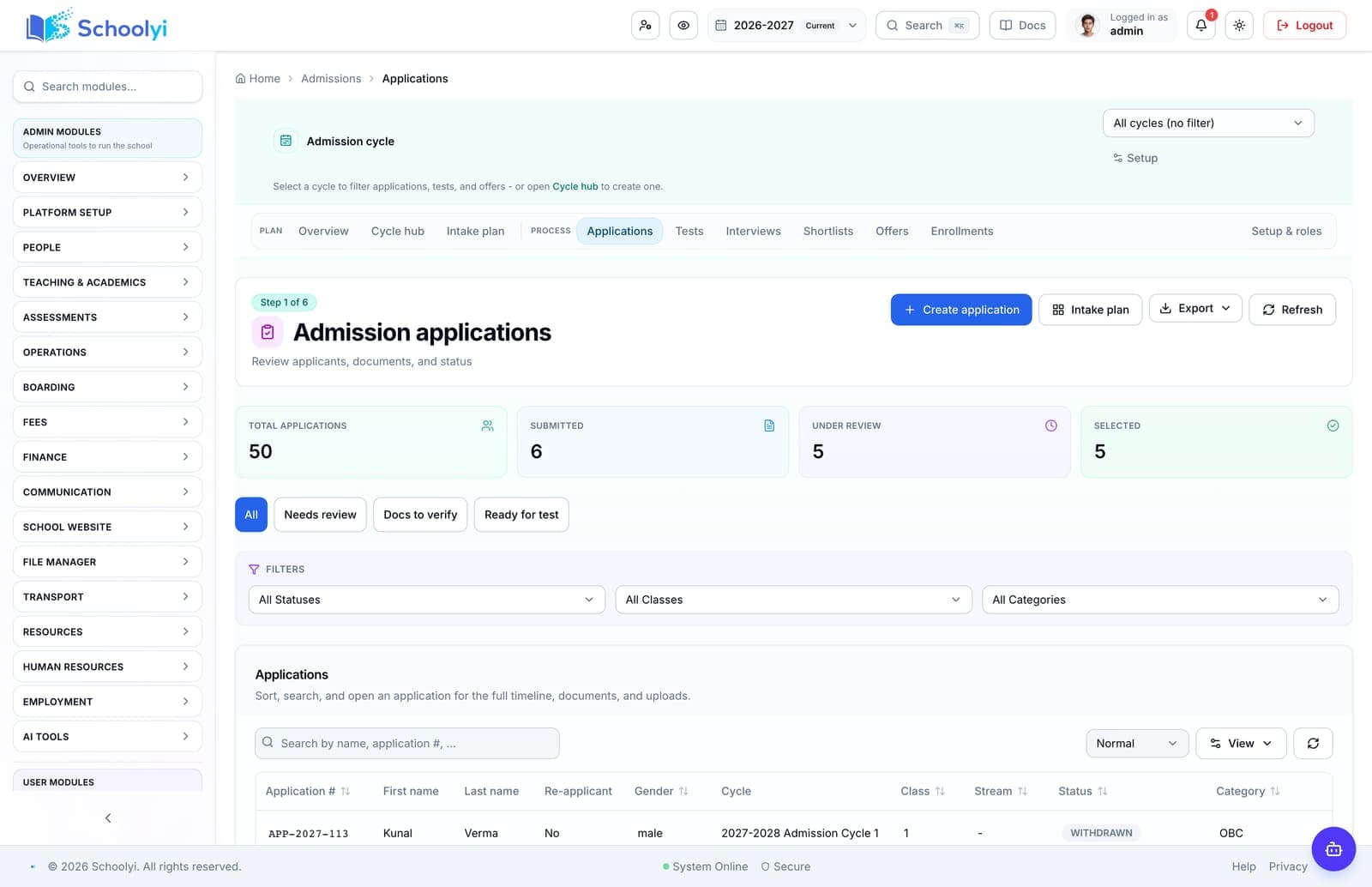
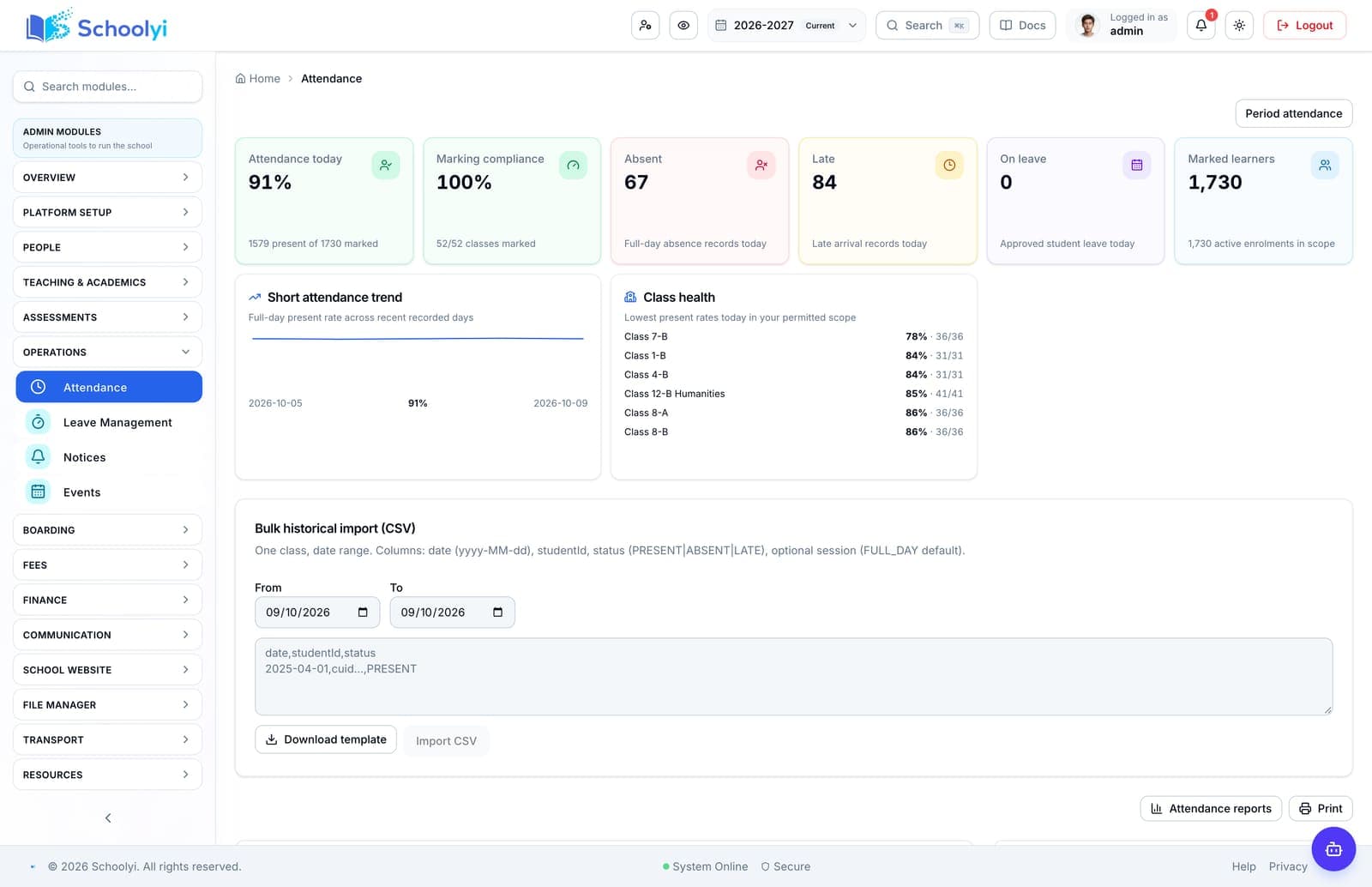
Schoolyi screens
The product these pages are comparing
Command center, fees, admissions, and attendance from a Schoolyi demo school.
Evidence basis
Where the facts on this page come from
Checked against PowerSchool's own published pages. Nothing here is sourced from a review site, an analyst summary, or a sales conversation.
We have no published switcher case studies. Nothing on this page describes a school that moved between these platforms, because we hold no permissioned account of one. The migration notes below are what any move of this kind requires, not a record of one we have run.
- PowerSchool, All Products, read 29 August 2026
This page was last checked against those sources on 29 August 2026. If it falls out of date, it stops being published rather than staying up unverified.
PowerSchool
What PowerSchool is
Described in PowerSchool's own terms before any comparison.
PowerSchool is a US-headquartered education software group whose products cover student information, enrollment, special programs, assessment, learning management, communications, finance, and HR. It presents these as one connected operating system spanning "home to classroom to central office", with the district rather than the individual school as the unit of deployment.
The suite is assembled from a number of separately built products, several carrying their original names alongside the PowerSchool label, Schoology for learning management, SchoolMessenger for communications, Performance Matters for assessment, Allovue for financial strategy. A school adopting several capabilities is therefore adopting several products that have been brought together, rather than one application.
The published solution structure is organised around district accountability: enrollment projection against budget, talent pipeline for unfilled roles, multi-tiered systems of support, chronic absenteeism, and college and career readiness. These are the concerns of a public district office, and the product surface reflects that.
Sourced facts
- PowerSchool describes its offering as the "K-12 Connected Operating System" and organises it around three stated areas of impact: home connections, student achievement, and operational excellence.PowerSchool, All Products, 29 August 2026
- The published product list groups more than a dozen named products, including PowerSchool SIS, Enrollment, Special Programs, Communications (SchoolMessenger), Learning Management (Schoology), Assessment (Performance Matters), MTSS, Financial Strategy (Allovue), ERP Systems, and Recruiting and HR.PowerSchool, All Products, 29 August 2026
- Several products are presented under both a PowerSchool name and the name they were built under, indicating a suite assembled from separately developed applications.PowerSchool, All Products, 29 August 2026
- The solutions page addresses the district as the buyer, referring to central office, boards, community spending accountability, and district-level enrollment projection.PowerSchool, All Products, 29 August 2026
- PowerSchool does not publish per-student or per-school prices on its solutions pages; the stated route is to speak to an expert.PowerSchool, All Products, 29 August 2026
Acknowledged
What PowerSchool does well
Stated without qualification, because a comparison that finds nothing good in the other product is not a comparison.
- Breadth is real. A district that needs student information, assessment, learning management, communications, finance, and HR can source all of it from one vendor under one commercial relationship.
- The district-level analytics, enrollment projection against budget, chronic absenteeism patterns, multi-tiered support data, are built for a reporting layer that sits above the individual school, and few platforms attempt that.
- US K-12 compliance and reporting requirements are a first-class concern rather than a regional adaptation, which matters a great deal if you are a US public district.
- The installed base and market presence mean an abundance of implementation partners, trained administrators in the hiring pool, and third parties that already integrate.
Schools PowerSchool is the right choice for
- US public school districts, particularly those managing several schools from a central office.
- Districts with statutory state reporting obligations that need those built in rather than configured.
- Organisations with a dedicated IT function able to own a multi-product suite.
- Buyers who prioritise breadth from a single vendor over a single application.
Fit constraints
Where the fit runs out
These are scope decisions rather than defects. A platform built for one kind of institution is not deficient for being unlike another.
- The unit of design is the district. An independent single-campus school is not the shape of institution the product structure assumes, and much of the district reporting layer has no counterpart in its operations.
- A suite assembled from separately built products means capabilities that arrive as adjacent applications rather than as one interface, with the integration work that implies.
- The published concerns, state reporting, MTSS, US college readiness, are specific to the US public system and do not map onto IB, IGCSE, CBSE, or national-board schools outside it.
- Fee collection as an independent school understands it, with instalment plans, sibling discounts, and counter receipts, is not what a district finance product is built around, because US public districts do not charge tuition.
Schoolyi
Where Schoolyi works differently
Differences in design, not a scorecard. Some of these will count against us for your school.
One application, not a suite
Schoolyi is a single application in which admissions, fees, timetable, attendance, assessment, and the family portal read the same student record, guardian relationships, academic calendar, and permission model. There is no synchronisation between products because there are no separate products. That is a narrower proposition than a district suite, and it is a different one.
The school is the unit, not the district
Schoolyi is scoped to how an individual school runs, with multi-campus groups switching school context after sign-in. There is no central-office reporting layer above the school, because the schools we build for do not have one.
Tuition and fee collection are core, not peripheral
Fee-paying schools need instalment structures, sibling and staff discounts, counter receipts, and defaulter follow-up attached to the same student record admissions created. This sits at the centre of Schoolyi rather than at the edge, because our schools charge fees.
Curriculum plurality rather than one national system
IB criterion levels, IGCSE tiering, CBSE and other national-board grading are configured against one roster rather than requiring separate deployments. This is a requirement of international and independent schools and is largely irrelevant to a US public district.
Migration
What a move between the two would require
General requirements of a migration of this kind. Not a record of one we have run.
- Historical academic records are the first question, not the last. Establish where transcripts for former students will live and who can issue them before any data moves, because in several jurisdictions retention is a regulatory obligation rather than a preference.
- Guardian relationships rarely survive a naive export. Expect to reconcile which adult is which, and which children they are linked to, before import, this is where duplicates originate.
- A district suite may hold assessment and learning-management data with no counterpart in a single-application platform. Decide explicitly what is being retired rather than migrated.
- Sequence by dependency, not by urgency: student identity and the academic calendar first, then admissions and fees, then teaching operations, then assessment. Every shortcut here is paid for twice.
Read the implementation guides for how a phased rollout is normally sequenced, or compare schoolyi and powerschool side by side.
Schoolyi and PowerSchool: common questions
Including the questions where the answer does not favour us.
Is Schoolyi a replacement for PowerSchool?+
For a US public district, no. The district reporting layer, state compliance reporting, and the assessment and learning-management products have no equivalent in Schoolyi, and we would not claim otherwise.
For an independent, international, or fee-paying school that found itself buying a district platform, Schoolyi covers the operations that school actually runs.
How do the two compare on price?+
Neither vendor publishes prices you could compare. PowerSchool directs buyers to speak to an expert; Schoolyi quotes against scope, student count, and implementation effort.
Any published comparison of the two figures would be invented, so we do not offer one.
Has any school moved from PowerSchool to Schoolyi?+
We have no permissioned account of one to publish. If we had, it would appear here with the school named and quoted.
The migration notes on this page describe what a move of this kind requires, which is a different thing from evidence that we have run one.
What would make PowerSchool the right choice over Schoolyi?+
Being a US public district with state reporting obligations, a central office coordinating several schools, and a need for assessment and learning management from the same vendor.
In that situation the breadth is the point and Schoolyi is the wrong shape of product.

Bring your own awkward cases to a walkthrough
The fee rule you find hardest to explain, the mid-year transfer, the guardian with children in two year groups. Those decide the fit far better than a comparison page can.
Already using Schoolyi? Sign in